 kiruthika
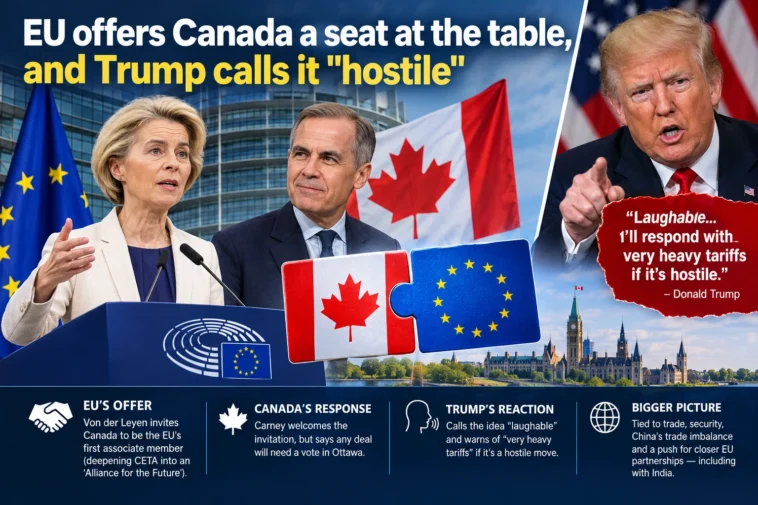
Ursula von der Leyen spent much of Wednesday’s State of the Union address in Strasbourg building toward one line: “I invite Canada to be the first associate member of the EU.” Canadian Prime Minister Mark Carney welcomed the invitation for his country to become the European Union’s first-ever “associate member” in a speech delivered before the European Parliament the following morning. By Wednesday evening, Donald Trump had already weighed in from North Carolina, calling the idea “laughable” and warning of retaliation if he judged it a hostile move.
It made for an odd 24 hours in Strasbourg — a hall used to ceremony suddenly at the center of a live transatlantic argument.
What happened
Associate membership isn’t a real thing yet, at least not in EU law. The status does not currently exist under EU treaties, and von der Leyen did not spell out what rights or obligations would come with it. What she did lay out was a direction of travel: deepening the existing CETA trade pact into something she called an “Alliance for the Future,” touching trade, technology, defence production and even a joint Arctic project.
Carney, sitting in the chamber as her guest of honour, was careful not to get ahead of the offer. His office had already signalled it was after a “unique alliance” with Europe rather than formal membership of any kind, and when he addressed MEPs himself the next day he stressed that whatever emerges would still need to go to a vote back home in Ottawa.
Trump wasn’t waiting for the fine print. Speaking to reporters in Charlotte, North Carolina, he said his response would depend on what European leaders were trying to achieve, calling the idea “laughable” and adding, as he put it, that it would be fine “if it’s a good intention” but he’d respond with “very heavy tariffs” if not.
Why now
None of this is happening in a vacuum. Canada has been trying to put daylight between itself and Washington for months, after Trump slapped a 50% tariff on Canadian goods and moved to restrict dairy, alcohol and auto imports. Canadian exports to the U.S. dropped 5.8% last year while exports elsewhere jumped 17.2%, though Washington still buys the large majority of what Canada sells abroad — which is exactly why Ottawa is hedging rather than leaping.
For von der Leyen, the Canada pitch was one plank in a much longer speech about Europe going it alone. She used the address to propose a “European Security Council” bringing in Britain, Ukraine, Norway and Canada, a NATO-style emergency mechanism for hybrid attacks, and — separately — a warning to Beijing that Europe’s roughly €1-billion-a-day trade deficit with China “has reached a tipping point.” She gave that negotiation an October deadline. Exactly how “associate membership” for Canada would work in practice, and whether the EU’s 27 member states will even sign off on it, remains unresolved.
Reactions
The European Commission tried to lower the temperature on Trump’s tariff threat, telling reporters the plan wasn’t “against anyone.” Inside the Parliament, the reaction to von der Leyen’s speech as a whole was messier than that one line suggested — MEPs from both the left and the right found things to criticize, from the pace of EU deregulation to why the UK, not Canada, wasn’t first in line for closer status. Left group leader Manon Aubry put it bluntly, asking who had given von der Leyen a “democratic mandate” to make such an offer at all.
The India angle
There’s no direct India thread running through the Canada announcement itself, and it would be a stretch to force one in. But two adjacent pieces of the same speech are worth watching from New Delhi. First, the EU’s long-running free trade talks with India, which both sides have said they want to wrap up by the end of this year, sit inside the same push von der Leyen described — an EU trying to lock in deeper economic partnerships with countries outside its usual orbit. Second, her tougher language on China’s trade surplus, backed by an October deadline for talks, could reshape trade and investment flows in sectors — steel, EVs, solar components — where Indian exporters compete directly with Chinese ones.
What to watch
Carney and EU leaders are due to meet in Montreal next month, where the shape of any “Alliance for the Future” should get more concrete. Whether the phrase “associate membership” survives that process intact, or gets quietly reworded into something less politically loaded, is still an open question — as is how far Trump is willing to go if he decides the deal has crossed from partnership into provocation.
FAQs
European Commission President Ursula von der Leyen invited Canada to become the EU’s first “associate member,” a proposed status that would deepen cooperation in areas such as trade, technology, defence and Arctic initiatives.
No. The proposal is not full EU membership, and “associate membership” does not currently exist as a formal status under EU treaties. The details and legal framework would still need to be developed and agreed upon.
Trump described the idea as “laughable” and said the United States could impose “very heavy tariffs” if he considered the move hostile, while also saying it could be acceptable if the intention was positive.
Canada is looking to strengthen relationships with partners outside the United States amid trade tensions and tariffs. Closer cooperation with Europe could give Ottawa additional economic and strategic partnerships.
Canadian and European leaders are expected to discuss the proposed “Alliance for the Future” at a meeting in Montreal next month. That meeting could provide more details about what closer EU-Canada cooperation would look like.


GIPHY App Key not set. Please check settings