 kiruthika
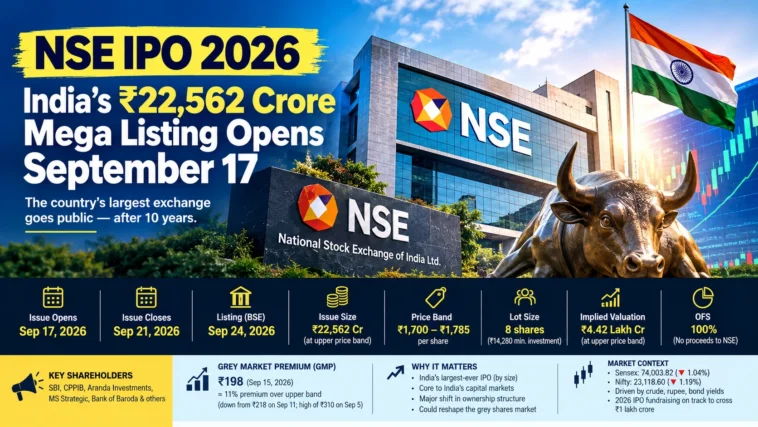
After nearly a decade of delay, the National Stock Exchange of India Ltd (NSE) — India’s largest stock exchange by trading volumes and the world’s largest exchange by equity-derivatives contracts traded, is finally going public. NSE first filed its IPO papers back in December 2016, and the long-awaited issue will open for public subscription on September 17, 2026, closing on September 21. Anchor investor bidding takes place today, September 16, ahead of the public launch. Shares are expected to list on the BSE, since NSE cannot list its own shares on the exchange it operates, around September 24, following allotment on September 22.
The Numbers
- Price band: ₹1,700–₹1,785 per equity share
- Issue size: ₹22,561.57 crore (roughly ₹22,562 crore) at the upper end of the band
- Structure: 100% Offer for Sale (OFS) — up to 12.64 crore equity shares (12,64,36,650 shares) being sold entirely by existing shareholders. NSE itself will not receive any proceeds from the issue.
- Lot size: 8 shares, with a minimum investment of ₹14,280 at the upper price band
- Implied valuation: Approximately ₹4.42 lakh crore at the top end of the price band
- Financials (as reported in the RHP and cited by financial media): Revenue of ₹18,713.37 crore in FY26, down slightly from ₹19,176.83 crore in FY25; net profit of around ₹10,300 crore in FY26, down from ₹12,187.69 crore in FY25
- Grey market premium (GMP): As of the most recent tracked reading (September 15, 2026), NSE’s GMP stood at roughly ₹198, implying a listing price near ₹1,983 — a premium of about 11% over the upper price band. This is down from ₹218 on September 11 and a high of ₹310 recorded on September 5, suggesting grey-market enthusiasm has cooled somewhat as the issue nears its open date. GMP is unofficial, unregulated, and changes daily, so any figure should be read only as a same-day sentiment snapshot, not a listing-price forecast.
The overall issue size was trimmed from an earlier estimate of nearly ₹30,000 crore after several major shareholders reduced the number of shares they plan to offload. Sellers in the OFS include State Bank of India, Canada Pension Plan Investment Board, Aranda Investments (Mauritius), MS Strategic (Mauritius), and Bank of Baroda, among others.
Why It Matters
At the upper end of the price band, the NSE IPO ranks among India’s largest-ever public offerings, with an issue size of about ₹22,562 crore. (Exact rankings against past mega-issues like LIC and Hyundai Motor India vary slightly across reports depending on how each calculates final issue size, so this piece avoids pinning down a precise numbered rank.) What is not in dispute is the scale and significance of the listing: NSE sits at the very centre of India’s capital markets — nearly every retail investor, trader, brokerage, and mutual fund in the country interacts with it directly or indirectly, and its dominance in the derivatives segment is especially pronounced. A stake sale of this magnitude by long-time institutional shareholders marks a significant shift in the ownership structure of India’s core market infrastructure, not just another company going public.
The listing is also expected to reshape a large but lesser-known corner of Indian finance: the unlisted or “grey” shares market. NSE stock has reportedly accounted for close to half of all trading volume in that shadow market, according to industry estimates cited by international financial media. Once NSE shares list formally on the BSE, platforms that facilitate informal pre-IPO share trading will need to find their next big draw.
Context: The Bigger Trend
The NSE IPO lands at a turbulent moment for Indian equities. On September 15, the Sensex fell 777.94 points (1.04%) to close at 74,003.82, while the Nifty dropped 279.50 points (1.19%) to settle at 23,118.60. The sell-off was driven by crude oil prices holding above $105–108 a barrel, a weakening rupee, rising bond yields, and investor caution ahead of the US Federal Reserve’s upcoming policy decision.
Despite this volatility, 2026 has otherwise been a strong year for India’s primary markets. Total IPO fundraising for the year is on track to cross ₹1 lakh crore, with mainboard issues alone having already raised more than ₹22,500 crore — a figure that doesn’t even include NSE’s own offering. The exchange’s listing arrives as the capstone of what has already been an active year for new-age and legacy companies alike hitting Dalal Street.
What Analysts Are Watching
Market watchers are focused on a few key signals in the days ahead. Anchor investor allotment results, expected later today, will offer an early read on institutional appetite for the issue. Subscription levels across the Qualified Institutional Buyer (50% reservation), Non-Institutional Investor (15%), and Retail (35%) categories through the September 17–21 window will indicate broader demand. The cooling grey market premium — down from its September 5 peak — suggests some tempering of initial excitement, though sentiment could shift again once formal bidding begins and institutional demand becomes visible.
What’s Next
- Anchor book allotment outcome (September 16)
- Public subscription window (September 17–21)
- Allotment finalisation (September 22)
- Listing on the BSE (expected September 24)
- Post-listing trading action, closely watched given NSE’s central role in Indian markets, and its performance against the backdrop of ongoing macro pressures — crude prices, rupee movement, and the Fed’s rate decision



GIPHY App Key not set. Please check settings