 kiruthika
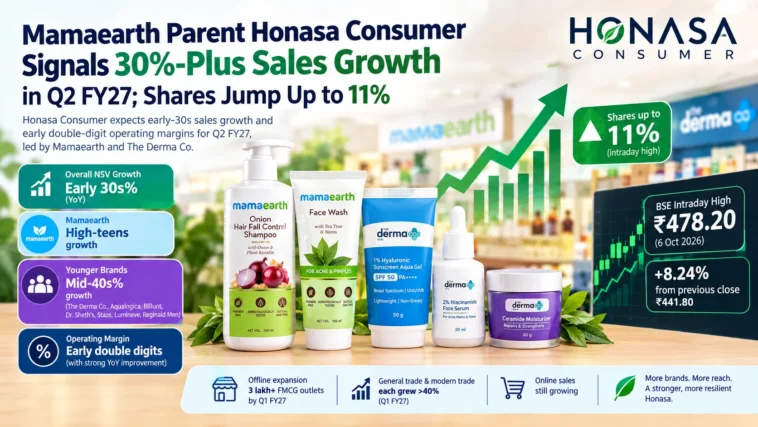
Honasa Consumer Ltd, the company behind Mamaearth and The Derma Co., has told the stock exchanges that its September quarter is shaping up strongly. In a business update filed on Tuesday, 6 October 2026, the company said it expects net sales value (NSV) for the second quarter of FY27 to grow in the early thirties, in percentage terms, compared with the same period last year.
The company described the update as provisional and voluntary. It is still subject to limited review by the statutory auditors and is not formal financial results or earnings guidance. The market reacted quickly all the same.
The Numbers
Honasa’s update broke its growth down by brand and margin:
- Overall NSV growth: early 30s per cent, year-on-year
- Mamaearth: high-teens growth, helped by stronger brand affinity and a wider offline footprint
- Younger brands: growth accelerating to around the mid-40s per cent. This group includes The Derma Co., Aqualogica, BBlunt, Dr. Sheth’s, Staze, Lumineve and Reginald Men.
- Operating margin: expected in the early double digits, with strong year-on-year improvement
The shares hit an intraday high of ₹478.20 on the BSE on 6 October 2026, up 8.24% from the previous close of ₹441.80. At 10:03 am IST the stock was trading at ₹472.35, up 6.9%. Gains widened as the session went on, and several reports put the peak rise at close to 11%. (Price data as recorded during trading on 6 October 2026; share prices change constantly.)
The stock was already on a strong run before the update. It had gained more than 61% over the previous six months and over 73% since the start of 2026.
Why It Matters
For investors, the margin signal matters more than the headline growth figure.
A year ago, in Q2 FY26, Honasa reported like-for-like revenue of ₹566 crore, EBITDA of ₹48 crore and an EBITDA margin of 8.4%. An early double-digit margin this quarter would mean profitability is holding well above that level, even as the company spends to expand.
There are two caveats. First, NSV is not the same as reported revenue. A change in Flipkart’s settlement mechanism has affected how Honasa records some of its marketplace sales, so the two figures can differ. Second, the margin may come in below the previous quarter’s level. In Q1 FY27, Honasa posted like-for-like revenue of ₹785 crore, up 31.8%, with a 14.1% EBITDA margin. Management has said seasonal and one-off factors helped that quarter, so a lower Q2 margin would not by itself point to weakness.
The growth of the younger brands also matters, because it reduces Honasa’s dependence on its flagship. The Derma Co. had already crossed ₹1,000 crore in annualised NSV by Q1 FY27, with EBITDA margins in the teens. If Mamaearth keeps growing while the newer brands add more profit, the business becomes much more resilient.
Context: From Digital Darling to Offline Rebuild
The size of Honasa’s recovery makes more sense when set against its fall. About a year after listing in November 2023, the company slipped into a loss in the September 2024 quarter as revenue fell 7%. Its shares then lost 36% in three trading sessions.
The turnaround came mainly from rebuilding its offline business. Under Project Neev, which began in late 2024 and settled down during 2025, Honasa overhauled how it reached physical stores. By Q1 FY27, its products were available in about 3 lakh FMCG outlets. General-trade secondary sales and modern-trade offtake each grew more than 40% in that quarter.
The Q2 update said offline channels are still leading growth. General trade is gaining from deeper direct distribution, and modern trade from better execution at the point of sale. Online sales are also still growing.
Many digital-first consumer brands in India are following the same path. Online sales got them started, but scale increasingly comes from the kirana store and the supermarket shelf. That shift brings its own costs, including distributor margins, trade schemes and a larger field sales force. The real test is whether wider reach can come without giving up margin.
What to Watch Next
The board-approved Q2 FY27 results will show whether this momentum turns into reported profit. Last year, Honasa reported its September-quarter numbers in mid-November.
Four things are worth tracking:
- Reported revenue against NSV growth. The Flipkart accounting change means the two can diverge.
- The final EBITDA margin. “Early double digits” covers a range of roughly 10% to 13%.
- Advertising and selling costs. These will show whether growth is coming efficiently or being bought with heavier spending.
- Input costs. JPMorgan has flagged crude-linked packaging inflation as a risk to Q2 gross margins.
Festive-season demand, which began picking up this month, will mostly show up in the December quarter. Still, Q2 results should give an early read on how much momentum Honasa carries into the second half of FY27.
FAQs
Honasa Consumer expects net sales value (NSV) to grow in the early 30% range year-on-year, with operating margins expected to reach the early double digits.
Mamaearth is expected to deliver high-teens growth, while younger brands including The Derma Co., Aqualogica, BBlunt and Dr. Sheth’s are growing at a faster pace.
Shares rose after the company signalled strong Q2 FY27 sales growth and improving operating margins, strengthening investor confidence in its turnaround.
NSV measures the value of sales before certain accounting adjustments, while reported revenue follows the company’s accounting treatment. Marketplace settlement changes can cause the two figures to differ.
Investors should focus on reported revenue, EBITDA margin, advertising and selling expenses, input costs and the performance of Mamaearth and Honasa’s younger brands.


GIPHY App Key not set. Please check settings