 shanprakash
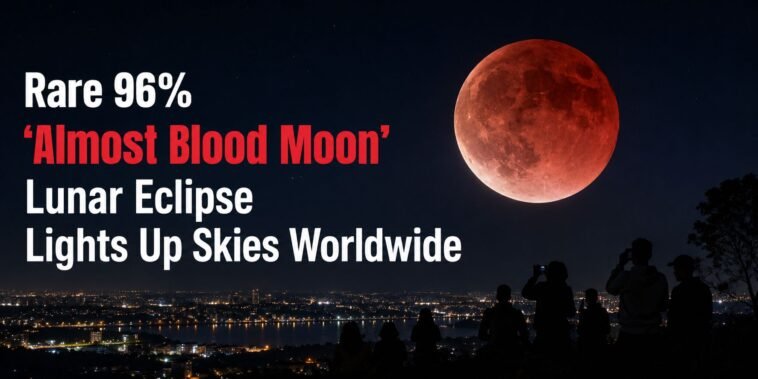
Skywatchers across the world got a treat this week as a deep partial lunar eclipse turned the Full Moon into a glowing copper disc. The event, which unfolded on the night of August 27 into the early hours of August 28, 2026, was one of the most striking lunar eclipses in recent years.
While it was technically a partial lunar eclipse, the numbers made it feel almost total. At its peak, roughly 96% of the Moon’s surface slipped into Earth’s darkest shadow, known as the umbra. Only a slim, bright sliver of the lunar disc remained untouched.
What Made This Lunar Eclipse So Rare
Astronomers have been calling this a “deep partial lunar eclipse” because of how close it came to being a full total eclipse. According to NASA and independent astronomy trackers, the moment of greatest eclipse occurred at around 4:12 a.m. UTC on August 28, when 96.3% of the Moon’s disc was inside Earth’s umbral shadow.
That makes it the most dramatic lunar eclipse seen anywhere on Earth since September 2024, and experts say nothing this striking will happen again until a total lunar eclipse arrives on December 31, 2028.
The reddish or copper tint often linked to lunar eclipses comes from sunlight bending through Earth’s atmosphere. Blue light scatters away, while red and orange wavelengths pass through and reach the Moon, giving it that famous “Blood Moon” glow, even though this wasn’t officially a full Blood Moon event.
Who Got the Best View
Visibility depended heavily on location and local weather conditions:
- North and South America had the best overall view, with the Moon high in the sky during the eclipse’s peak.
- Europe and Africa saw the eclipse closer to moonset, catching the early and middle stages before the Moon dipped below the horizon.
- Parts of the Middle East and eastern Europe saw the partial phase just before moonset.
- Much of Asia and Australia, including India and China, missed the event entirely since the Moon was below the horizon during eclipse hours.
In the United Kingdom, the partial phase began around 3:33 a.m. BST, with maximum eclipse near 5:12 a.m., giving early risers a narrow window to catch the show.
No Special Equipment Needed
Unlike a solar eclipse, this event required no eye protection at all. Lunar eclipses are completely safe to watch with the naked eye, and observers didn’t need eclipse glasses, filters, or specialized gear.
Binoculars or a small telescope enhanced the colors and contrast, but even city dwellers with a clear view of the sky were able to enjoy the eclipse without any special setup.
Why the Event Trended Online
The eclipse quickly became a trending topic on social media and search engines, with many people searching terms like “lunar eclipse tonight,” “Blood Moon August 2026,” and “when is the next lunar eclipse.” The buzz was driven partly by its rarity and partly by wide visibility across heavily populated regions, including North America and parts of Europe.
Photographers and amateur astronomers shared images throughout the night, comparing notes on the Moon’s changing color as it moved deeper into Earth’s shadow.
What’s Next for Skywatchers
For those who missed it or want more, astronomy trackers note the next lunar eclipse of similar depth won’t occur until January 2028, and that one will be far less dramatic, with only about 2.4% of the Moon passing through Earth’s umbra.
The next total lunar eclipse, when the entire Moon turns red, is expected on December 31, 2028.
Final Takeaway
This week’s deep partial lunar eclipse offered a rare, easy-to-watch cosmic event that brought skywatchers together across multiple continents. With nearly the whole Moon swallowed by Earth’s shadow, it delivered nearly all the drama of a total eclipse, minus the wait for totality. For casual stargazers and dedicated astronomers alike, it was a moment worth looking up for.



GIPHY App Key not set. Please check settings