 kiruthika
What happened
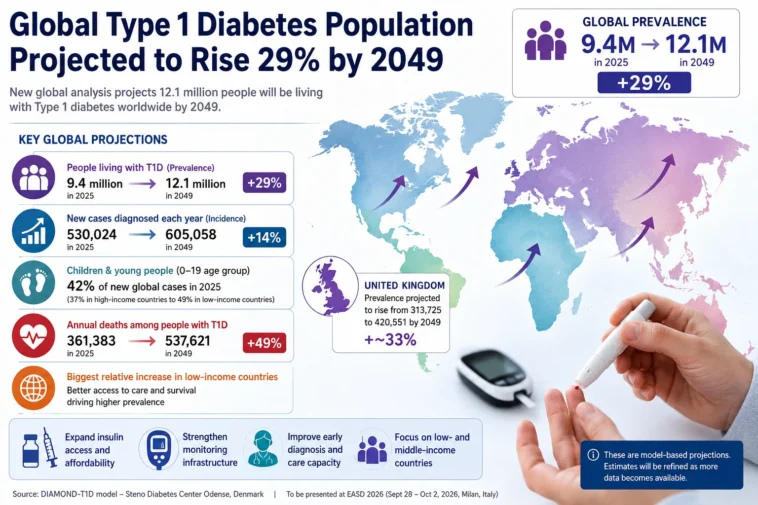
A new global analysis projects that the number of people living with Type 1 diabetes (T1D) worldwide will climb by 29% over the next two-and-a-half decades — from 9.4 million in 2025 to 12.1 million in 2049. The research, developed using a model called DIAMOND-T1D and led by Professor Anders Green at the Steno Diabetes Center Odense in Denmark, is scheduled to be presented at the Annual Meeting of the European Association for the Study of Diabetes (EASD) in Milan, Italy, from September 28 to October 2, 2026 — the findings have not yet been formally presented as of this writing.
The same model projects that the number of new T1D cases diagnosed each year will rise by 14%, from 530,024 in 2025 to 605,058 in 2049 — a smaller increase than the prevalence figure, since prevalence also reflects more people surviving longer with the condition.
Why it matters to the general reader
Type 1 diabetes is an autoimmune condition in which the body’s immune system attacks the insulin-producing beta cells in the pancreas. It is not caused by the lifestyle factors — diet, weight, activity level — commonly associated with Type 2 diabetes, and it typically requires lifelong insulin therapy from diagnosis onward. A projected 29% rise in the number of people living with T1D has direct implications for how much insulin, testing equipment, and trained healthcare staff countries will need to plan for in the coming years. It’s also a reminder that T1D’s burden is shifting toward regions least equipped to absorb it.
Background and context
Historically, most people living with T1D have been counted in high- and middle-income countries, partly because better healthcare and survival rates there meant more people lived long enough to be included in prevalence figures. That pattern looks set to shift. The largest relative increase in T1D prevalence is expected to occur in low-income countries, as access to insulin, glucose monitoring, and survival rates improve there — meaning more people are surviving with the condition rather than dying undiagnosed or untreated. Improved access to care is itself part of why the numbers are projected to rise: better survival shows up statistically as higher prevalence, not necessarily as a worsening epidemic.
The DIAMOND-T1D model is described by its developers as a new epidemiological tool that factors in historical incidence, population age structures, survival patterns, and insulin access across countries. It can be refined further as more T1D data becomes available — an acknowledgment that data quality on T1D, especially outside wealthy nations, has historically been patchy.
Key facts and data
- Global prevalence (people living with T1D): projected to rise 29%, from 9.4 million in 2025 to 12.1 million by 2049.
- New cases diagnosed per year (incidence): projected to rise 14%, from about 530,000 in 2025 to about 605,000 by 2049.
- Country-level example: the UK is projected to see prevalence rise by roughly one-third — over 100,000 more cases — from 313,725 to 420,551.
- Children and young people: the 0–19 age group is estimated to account for 42% of new global cases in 2025, ranging from 37% in high-income countries to 49% in low-income countries.
- Mortality: annual deaths among people living with T1D globally are projected to rise from 361,383 in 2025 to 537,621 by 2049, largely reflecting the growing total population living with the condition rather than worsening individual care.
- Researchers themselves caution that reliable T1D data remain limited, particularly in low- and middle-income countries, and stress that better epidemiological information is essential for planning healthcare services.
What readers should actually do or watch for next
This is a modeling and planning study, not a treatment breakthrough or an individual risk alert — there’s no new personal action item for most readers. The relevant takeaways are systemic rather than personal:
- For families managing T1D: nothing changes in day-to-day care. Continue following your endocrinologist’s guidance on insulin, monitoring, and diet management — this study doesn’t alter clinical protocols.
- For anyone noticing possible T1D warning signs — unusual thirst, frequent urination, unexplained weight loss, fatigue — in a child or adult, this is a prompt to consult a doctor for proper testing, not to self-diagnose from a global statistic.
- For policymakers and health systems: the study’s real message is about long-term planning — expanding affordable insulin access, glucose-monitoring infrastructure, and early-diagnosis capacity, especially in lower-income regions where relative growth is steepest.
- Readers should treat all figures here as model-based projections, not confirmed outcomes. The researchers themselves note that data gaps in poorer countries limit precision, and estimates will likely be refined once formally presented at EASD and as more T1D data becomes available.
FAQs
Type 1 diabetes is an autoimmune condition in which the immune system destroys insulin-producing beta cells in the pancreas. People with T1D generally need insulin therapy to manage blood glucose and stay healthy.
The DIAMOND-T1D model projects that the global number of people living with Type 1 diabetes could increase from 9.4 million in 2025 to 12.1 million in 2049, representing a 29% rise.
The projected rise reflects several factors, including population growth, changing age structures, ongoing T1D incidence, and improved survival as access to insulin and diabetes care improves, particularly in lower-income countries.
Not exactly. The 29% figure refers to the projected increase in the number of people living with T1D. The model projects a smaller 14% increase in new cases diagnosed each year. Higher survival also contributes to a larger number of people living with the condition.
No. The figures are projections generated by the DIAMOND-T1D epidemiological model. The findings are scheduled to be presented at the EASD Annual Meeting in Milan from September 28 to October 2, 2026, and future estimates may change as additional data becomes available.


GIPHY App Key not set. Please check settings